Wellness · 11 min read
Sauna and stress. Why do we feel so good after a sauna session?
Does sauna help with stress? See how high heat affects the nervous system, cortisol, sleep and recovery, and why we feel such deep calm after a session.
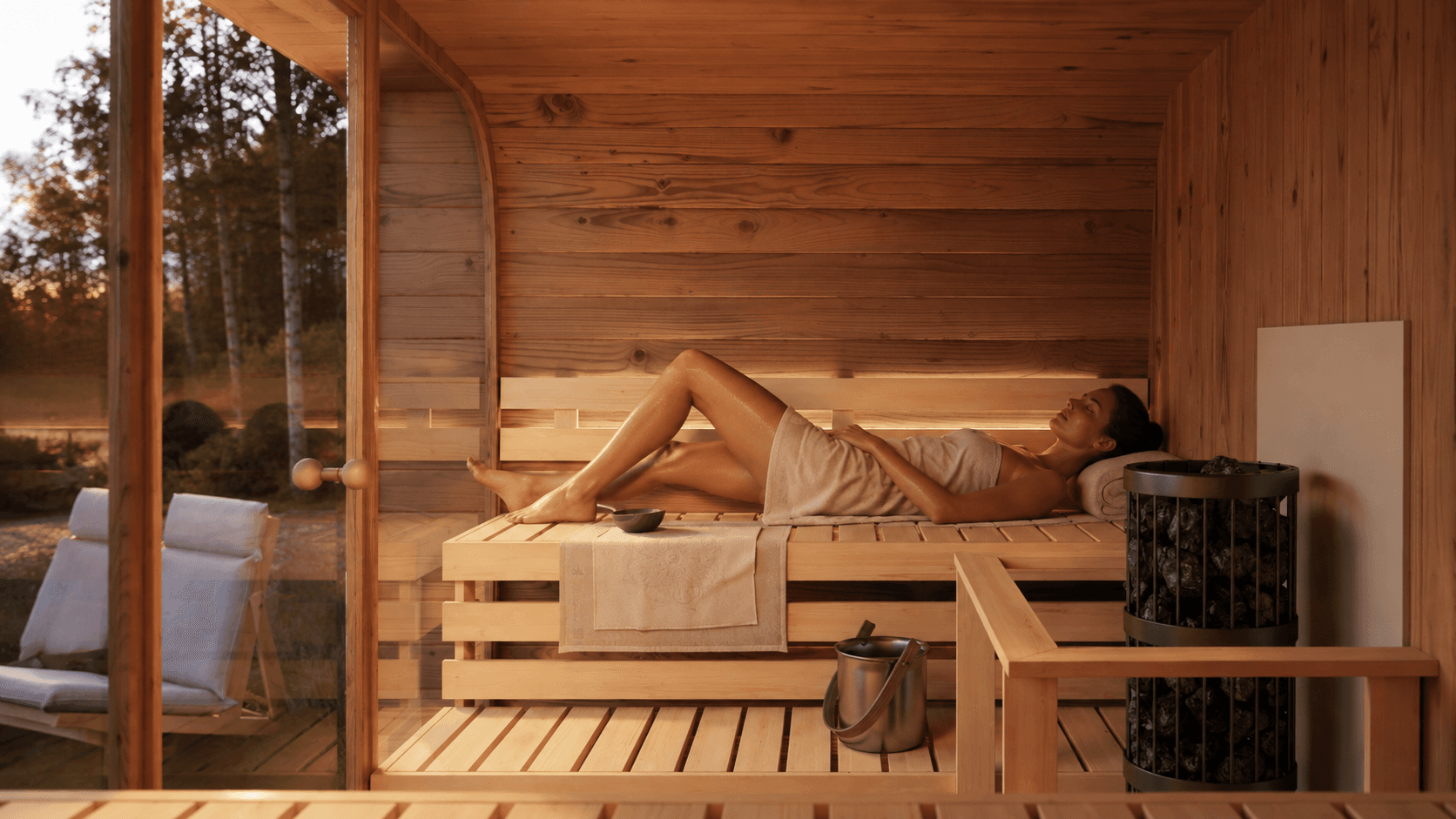
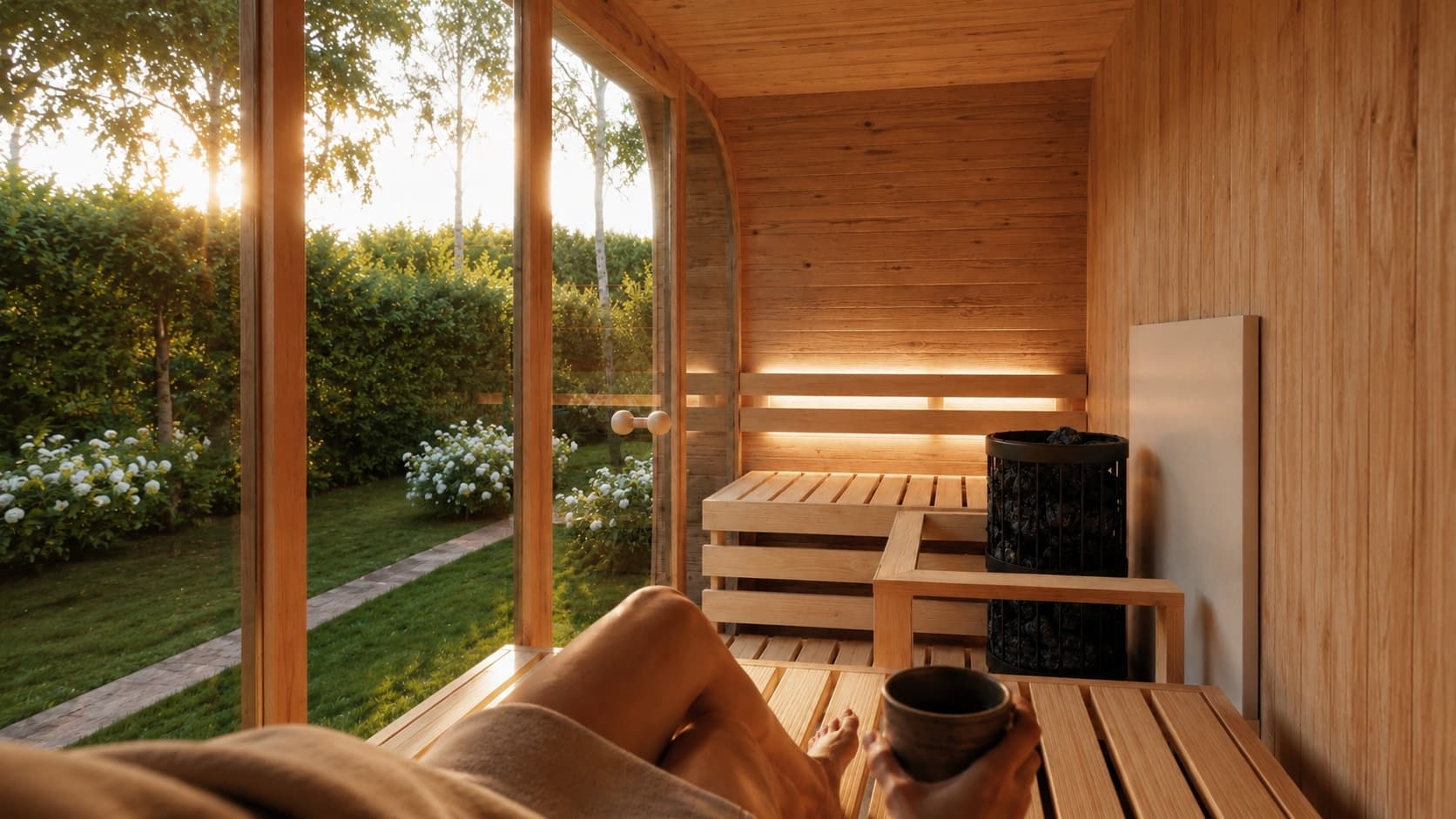
You step into the sauna after an intense day. Just minutes earlier your head was full of work, messages, obligations, deadlines and everything you still need to do tomorrow. You sit down, it goes quiet, the temperature rises, and your phone stays outside.
A dozen or so minutes later you step out, and something interesting happens.
The problems obviously haven't disappeared. Yet somehow they feel a little less overwhelming. Your body is relaxed, your mind is calmer, and the tension you could almost feel physically a moment ago starts to let go.
This doesn't have to be purely an effect of the atmosphere.
During a sauna session, the body goes through a series of very specific physiological changes. Circulation, thermoregulation and autonomic nervous system activity all shift. A growing body of research also suggests that regular heat exposure may be linked to better mental wellbeing and sleep quality. That said, scientific caution is warranted here – a sauna is not a treatment for anxiety disorders or chronic stress, but it can be a genuinely valuable part of everyday recovery.
 Sauna and stress. What actually happens in the body?
The paradox of the sauna is that, in order to calm us down, it first stresses us a little.
The temperature in a classic Finnish sauna can reach around 80 to 100°C. The body immediately notices it's in unusual conditions and starts shedding heat intensively. Blood vessels in the skin dilate, blood flow increases, we start to sweat, and the heart speeds up.
For the body, this is a short-term heat stressor.
But not every kind of stress should be treated as harmful. A short, controlled stimulus can trigger a completely different response than psychological stress that drags on for weeks or months.
In the scientific literature on heat exposure, the concept of hormesis comes up. It describes a situation where a small, controlled stressor prompts the body into an adaptive response. The sauna is one example of exactly that kind of stimulus.
It's a bit like the logic behind physical training. The workout itself is a load on the muscles. It's only the body's response, and the recovery that follows, that turns training into a benefit.
The sauna may work in a similar way.
Why does such deep relaxation follow a sauna session?
While you're in a hot sauna, the body is heavily occupied with thermoregulation. Once you step out, though, things start to change.
This is where research on the autonomic nervous system gets particularly interesting.
It's the part of the nervous system responsible for processes we don't usually think about consciously. Among other things, it regulates heart rate, blood pressure, digestion and the body's response to stress.
In broad terms, we can talk about two mechanisms.
- The sympathetic system mobilises the body for action.
- The parasympathetic system supports rest, digestion and recovery.
One study on sauna bathing found that heart rate rises during the session, while the later resting phase showed an increase in heart rate variability (HRV) and signs of the autonomic nervous system shifting toward recovery.
A review of research on passive heating similarly points to the sauna influencing autonomic nervous system modulation, though the authors stress that more research is still needed to pin down the exact scale and durability of these effects.
That may partly explain the state many people describe simply as:
It finally let go.
Sauna and cortisol. Does sauna really lower the stress hormone?
Cortisol is often called the stress hormone. That's a convenient label, though it oversimplifies things a bit.
The body actually needs cortisol. Among other things, it helps regulate metabolism and helps the body respond to demanding situations.
So the problem isn't cortisol itself, but a chronically disrupted stress response.
What does the sauna have to do with it?
Research doesn't show a simple mechanism where stepping into a sauna makes cortisol drop instantly for everyone. The hormonal response depends, among other things, on temperature, session length and how accustomed someone is to heat.
In classic studies on sauna bathing, cortisol levels in people used to sauna sessions generally didn't rise significantly. Another study on repeated sauna exposure observed a drop in both cortisol and ACTH by the end of the experiment.
That doesn't mean the sauna is a way to "flush out cortisol."
It points to something more interesting instead.
The body may be learning to handle predictable, controlled heat stress. And that's exactly why regular sauna bathing is such an interesting subject for research on stress and recovery.
After the sauna, the body really does work differently
The feeling of calm doesn't have to start purely in the mind.
Heat has a strong effect on the circulatory system.
During a session, blood vessels dilate and blood flow to the skin increases. Research also suggests that a single sauna session can affect arterial stiffness and blood pressure.
A broader meta-analysis of heat therapy research found a modest reduction in systolic and diastolic blood pressure, along with improvements in some vascular function markers, following repeated heat exposure.
That's why, after leaving the sauna, many people feel a distinctive softness and looseness throughout the whole body.
The heat stops being intense. You sit down or lie down. Your breathing slows. Your heart rate starts to settle.
A contrast appears.
Just moments earlier, the body was actively fighting to maintain the right temperature. Now it can finally start to rest.
That shift is probably one of the ingredients behind the famous post-sauna feeling of bliss.
The sauna also forces us to do something we almost never do anymore
There's one more mechanism you won't see in a blood test.
For a dozen or so minutes, we simply do nothing.
- We don't reply to messages.
- We don't scroll through social media.
- We don't work.
- We don't switch between five different apps.
- We don't solve problems.
We sit. We breathe. We feel the heat.
In a culture of constant notifications and endless stimulation, that situation has become surprisingly rare.
So the sauna can also serve as a ritual. The brain gets a clear signal that, for the next several dozen minutes, it doesn't need to respond to the outside world.
Of course, it's hard to separate physiology from psychology. And there's probably no real need to.
It's precisely this combination of heat, silence, rest, reduced stimulation and the cooling down that follows that makes the sauna ritual feel so deeply relaxing.
What happens in the brain during all this?
This is one of the most fascinating parts of the whole topic.
In a study published in 2023, researchers analysed brain activity and wellbeing in participants during a cycle involving a sauna session, a cold plunge and a rest period.
After the sauna and during the rest period, they observed, among other things, increased alpha and theta wave activity. These brain-activity patterns often appear during states of calm wakefulness and relaxation. The researchers also noted changes in participants' self-reported wellbeing.
This doesn't mean the sauna puts the brain into some magical state.
It does suggest, however, that the distinctive feeling after a session likely has a real neurophysiological basis.
Sauna and sleep. Why can an evening session feel so good?
Stress and sleep are very closely linked.
When we're stressed, we often sleep worse. When we sleep badly, we react more strongly to tension the next day. A vicious circle forms.
The sauna can be an interesting part of an evening routine precisely because it affects the body and the nervous system at the same time.
Research on passive heating suggests that heat exposure before bed can influence sleep. Older, small-scale sauna studies suggested an increase in deep sleep after a session, though the number of participants was very small and it's worth being cautious about drawing far-reaching conclusions from them.
Survey data paints an interesting picture too. In an international survey of sauna users, over 80 percent of respondents reported improved sleep after sauna bathing. It's worth remembering, though, that these were self-reported responses, not a controlled laboratory experiment.
So it's possible that part of the distinctive calm after an evening sauna session comes from the body smoothly shifting from active mode into a mode of preparing for rest.
Does sauna help with psychological stress?
Here it's important to separate two different things.
There's everyday stress after a hard day, intense work or a tough workout.
And there are anxiety disorders, depression, chronic stress or burnout, which require professional support.
The sauna can be a great recovery ritual, but it shouldn't be presented as a substitute for psychotherapy or medical treatment.
At the same time, population-level observations are interesting.
In a study carried out in northern Sweden, sauna users reported, among other things, better general and mental health, higher energy levels, and lower scores for mild anxiety and low mood compared with non-users. However, this is an observational association, so it can't tell us that the sauna itself caused these differences.
More recent publications also point to a potential role for regular heat exposure in mental health, but the evidence base is still developing, and some of the most appealing hypotheses still need confirmation in large clinical studies.
This matters, because it's easy to find claims online along the lines of "sauna cures stress."
Science says something a bit more nuanced.
Regular sauna bathing can be one element of a lifestyle that supports recovery and wellbeing.
Why does a sauna taste best after a hard day?
Probably precisely because of the contrast.
If you spend the whole day operating at high speed, talking to people, making decisions, solving problems and staring at a screen, moving into a hot, quiet room is a massive change of environment.
- Suddenly there's nothing you need to achieve.
- There's no result to hit.
- There are no notifications.
- There's no next task.
There's only heat, and time.
The body receives an intense but simple physical stimulus. After leaving, rest follows. The circulatory system gradually settles down. Autonomic nervous system activity shifts. Muscles feel looser.
And your mind finally has room to slow down.
That's why the sauna can be more than just a way to warm the body.
It can become the line between the part of the day when you have to perform, and the part when you can simply rest.
How to use the sauna to actually switch off?
If the main goal is mental recovery, there's no point treating the sauna like an endurance competition.
You don't need to sit at the highest possible temperature or check whether you can last a minute longer than last time.
Comfort matters far more.
Leave your phone outside. Sit comfortably. Give yourself a few minutes before you start analysing whether "it's working yet." Breathe calmly and let your body get used to the heat.
After the session, don't rush straight into the next task either.
The rest phase is part of the whole ritual.
It's precisely then that the most distinctive feeling of calm tends to appear.
Remember to stay hydrated, and avoid alcohol before and during sauna use. Anyone with cardiovascular conditions, blood pressure issues or other serious health problems should check with a doctor beforehand whether this kind of heat exposure is right for them. The sauna can significantly affect the circulatory system and blood pressure.
Sauna doesn't relieve stress by "sweating problems out"
And maybe that's the most interesting part of the sauna.
There's no single happiness hormone that switches on after ten minutes and suddenly lifts your mood.
The effect is probably the result of many processes acting at the same time.
- Heat.
- Changes in circulation.
- The autonomic nervous system's response.
- Rest following heat exposure.
- A break from excess stimulation.
- Silence.
- A conscious ritual.
- A possible positive effect on the sleep that follows.
Together, all of this creates a state that's hard to describe with a single medical term, but very easy to recognise once you've stepped out of a sauna yourself.
The body is tired in a pleasant way.
Breathing becomes calmer.
And the things that felt urgent half an hour earlier can wait a little longer.
That's exactly why, after a good session, we rarely say we feel "warmer."
I really needed that.